


A common misconception is that downloading a crypto wallet is mainly an installation task. In DeFi, it is closer to choosing the control panel for a set of financial permissions. The browser extension does not make a transaction safe by itself, and a polished interface cannot remove risks created by malicious contracts, compromised websites, or careless approval settings. What it can do is make those risks easier to inspect before signing
Комплексная многофакторная аутентификация надежно защищает. Используется в комплексной многофакторной аутентификации Кракен со всеми методами.
That distinction matters for US users moving among Ethereum and other Ethereum Virtual Machine (EVM) networks. Rabby is positioned as a wallet for Ethereum and EVM chains, and its recent project messaging emphasizes broad chain support and on-chain use through Chrome and Brave. The useful question is not whether the wallet is “secure” in the abstract. It is whether its transaction previews, network handling, approval controls, and swap workflow help a user make fewer expensive mistakes.
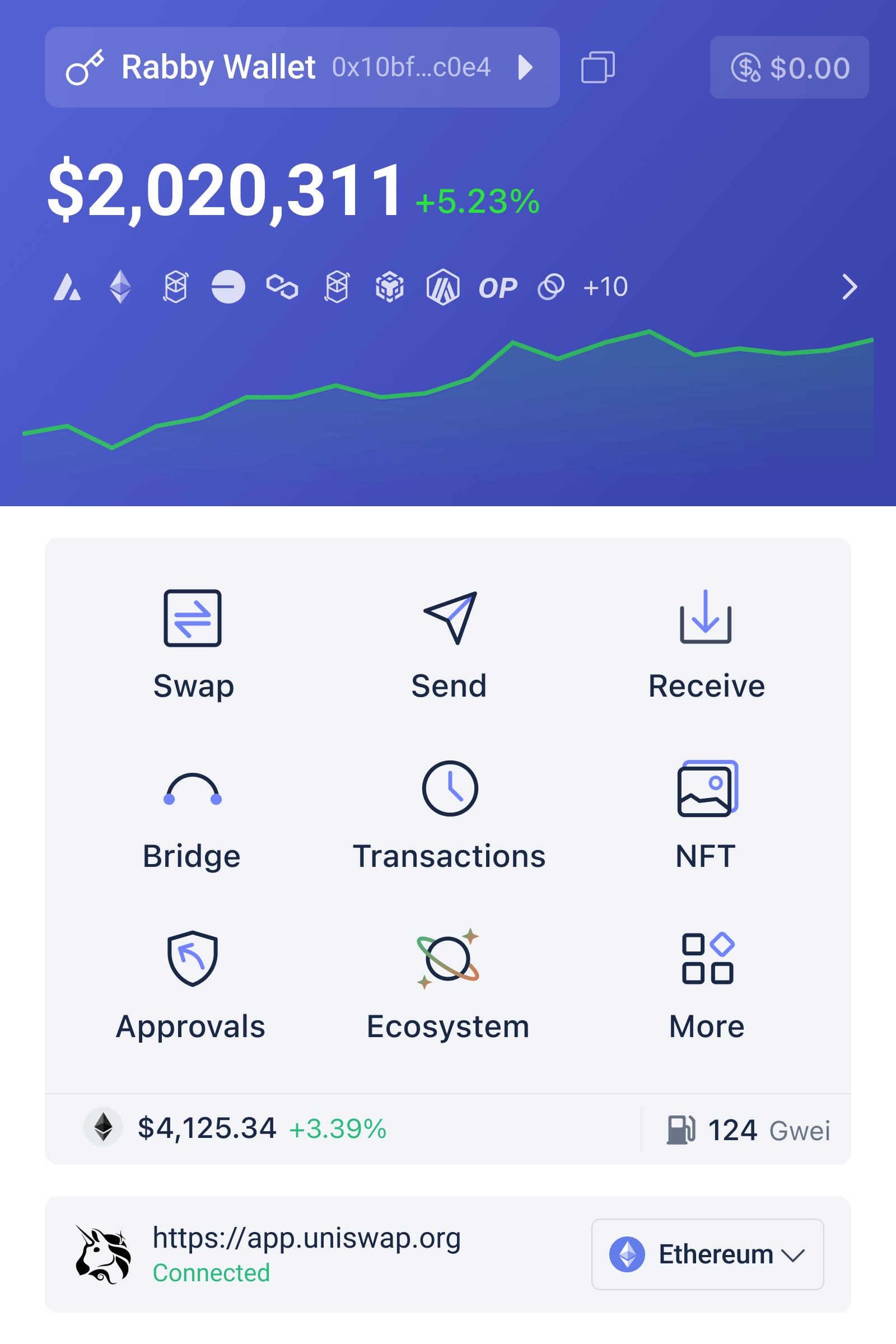
What a Rabby wallet download actually establishes
A browser wallet is a software interface that connects a user’s private key or hardware signer to decentralized applications. When installed as an extension, it can display account balances, identify supported networks, construct transactions, and request signatures. The signing authority still belongs to the wallet account. The extension does not hold a universal claim on a blockchain, nor does it reverse a transaction after it has been confirmed.
For that reason, installation should begin with source verification rather than a search-engine click. Users should confirm that the extension is obtained through an official Rabby distribution path or a recognized browser extension listing, inspect the publisher information, and avoid files or links delivered through unsolicited messages. A useful starting point for checking the intended extension is the rabby extension download page, but the same basic rule applies afterward: compare the extension identity, permissions, and browser origin before entering any recovery phrase.
During setup, the seed phrase is the most sensitive object in the entire process. Anyone who obtains it can generally recreate the wallet elsewhere, regardless of which interface was originally used. A recovery phrase should never be entered into a website, support chat, form, or “verification” page. If an existing wallet is imported, the user should also ask whether the browser profile is appropriate for that level of custody. A dedicated profile, updated operating system, password manager hygiene, and a hardware wallet for larger balances can reduce exposure, although none eliminates it.
The practical mental model is simple: Rabby can improve decision quality at the signing stage, but it cannot make an unsafe key-management environment safe. A wallet interface is a risk filter, not a substitute for operational security.
Why token approvals are more important than the token balance
Many DeFi users focus on the amount being transferred in the current transaction. A less obvious risk is the permission created by an earlier transaction. An ERC-20 token approval allows a designated smart contract, often called a spender, to move a specified amount of a token from the user’s wallet. That permission can remain active after the original swap, deposit, or liquidity action is finished.
This creates an important distinction between a transaction and an authorization. A transaction might swap $100 of a token today. An approval could authorize a contract to spend a much larger amount later, depending on the allowance set. If the contract is exploited, upgraded in an unsafe way, or simply not the contract the user believed it was, the standing permission may become the route through which funds are taken. The danger is therefore not limited to the moment of clicking “swap.” It can persist in the wallet’s relationship with the spender.
Approval management is not merely a cleanup habit. It is a way to reduce the maximum damage that a compromised or misunderstood contract can cause. Users should examine which contract is receiving permission, which token is affected, whether the allowance is limited to the expected amount, and whether the approval is still needed. A limited allowance can reduce potential loss, but it may require another approval later and can add network fees. An unlimited allowance is more convenient, yet it expands the consequence of a future problem.
Approval decisions require context
Revoking every approval immediately is not always the optimal strategy. Revocation is itself an on-chain transaction and requires gas on the relevant network. For a frequently used application, repeatedly approving and revoking may cost more and create more signing opportunities than a carefully limited, still-monitored allowance. For an abandoned application, an unfamiliar spender, or a contract associated with a suspicious interaction, revocation becomes more compelling.
The better framework is exposure management. Consider four questions: what asset is exposed, how large is the allowance, which contract controls the permission, and how likely is continued use? A small approval to a well-understood application is not equivalent to a large or unlimited approval to an unknown spender. Wallet warnings and transaction simulations can help, but they are indicators rather than guarantees. A simulation may fail to capture every future contract state, off-chain dependency, governance decision, or attack path.
Users should also remember that approvals are generally network-specific. An approval granted on Ethereum does not automatically authorize the same spender on Arbitrum, Base, Polygon, or another EVM chain. That separation is useful, but it can make portfolio hygiene harder because permissions are distributed across networks. A wallet showing many chains in one interface improves convenience while increasing the need to check the active network and the exact contract address.
Cross-chain swaps: a sequence of trust assumptions
The phrase “cross-chain swap” sounds like one action, but mechanically it can describe several different processes. A user may swap one asset on a single chain, bridge an asset to another chain, swap again there, or use a bridge-and-swap route assembled by an aggregator. The interface may compress those steps into one flow. The underlying trust assumptions do not disappear.
On a simple same-chain swap, a decentralized exchange contract usually receives token permission, takes the input asset, and returns the output asset according to the transaction’s parameters. A cross-chain route adds a message or asset-transfer layer. Depending on the design, funds may be locked and minted elsewhere, released by a liquidity provider, or represented through another mechanism. Each model has different dependencies: smart-contract correctness, validator or relayer behavior, liquidity, finality assumptions, and the accuracy of the destination address and network.
This is why a convenient cross-chain quote should be read as a route description, not a promise. A displayed output amount can change because of price movement, liquidity conditions, fees, and slippage. The receiving chain may also require its native gas token for a later transaction. A user who arrives on a new network with tokens but no gas may be unable to move, sell, or approve them until another transfer is made.
Before signing a cross-chain transaction, inspect the origin network, destination network, input token, expected output token, minimum received amount, estimated fees, and the entity or contract handling the transfer. Pay particular attention to token identity. Similar ticker symbols can represent different contracts, and a bridged representation is not automatically interchangeable with a native asset. For US users, this matters beyond price: records from multiple networks can make tax reporting and transaction reconciliation more complex, even when the wallet interface presents the activity as one streamlined action.
Rabby’s value in this workflow is primarily informational. If the wallet identifies the chain, contract interactions, balance changes, and approval requests clearly, the user has a better chance of noticing a mismatch before signing. That advantage depends on the quality of the available metadata and simulation. It does not mean every malicious contract, fake token, or economically unfavorable route will be detected.
A practical workflow for safer DeFi use
A disciplined workflow can be more valuable than any single wallet feature. First, install the extension from a verified source and create or import the account only in the intended browser environment. Next, separate everyday trading funds from long-term holdings when possible. Then, when connecting to an application, confirm the domain and the requested account before considering the transaction itself.
At the approval stage, ask whether the application needs permission for the exact token being used and whether the allowance can be limited. At the transaction stage, inspect the recipient, method, network, value, and expected balance change. For a swap, compare the minimum received amount with the quoted amount and consider whether slippage is plausible for the market. For a bridge or cross-chain route, treat the destination chain as a separate operational environment rather than an invisible extension of the first one.
Afterward, review the resulting approval and transaction history. If the application is no longer needed, decide whether the gas cost of revocation is justified by the value and risk of the permission. Keep a record of which assets are held on which networks. This sounds administrative, but it prevents a common failure mode: users remember the trade and forget the approval, bridge, or destination token created around it.
One useful rule is to distinguish reversible inconvenience from irreversible loss. Waiting for a quote, checking a contract, or paying a modest extra fee is usually an inconvenience. Signing a malicious approval or sending funds to the wrong chain may be irreversible. When those outcomes differ sharply, a slower review is rational even if the interface is designed for speed.
What the current Rabby direction means for users
The recent Rabby project messaging presents the extension as a broad interface for Ethereum and EVM-chain activity across browsers such as Chrome and Brave. That direction reflects a larger change in DeFi: the challenge is no longer only accessing one decentralized exchange. It is managing fragmented liquidity, multiple networks, permissions, and contract interactions without losing the context of what is being signed.
If wallet interfaces continue improving transaction simulation, chain detection, approval visibility, and route explanations, users may become better at identifying suspicious or inconsistent actions before confirmation. That is a conditional benefit, not a guaranteed outcome. Attackers can adapt, metadata can be incomplete, and users can still approve a warning after deciding that speed matters more than review.
The boundary is especially important for cross-chain activity. A wallet can show the route, but it cannot guarantee bridge solvency, honest governance, adequate liquidity, or favorable execution. Nor can it determine whether a user’s investment thesis is sensible. The interface can make assumptions visible; the user still has to evaluate them.
Rabby Wallet FAQ
Is Rabby itself a guarantee that a DeFi transaction is safe?
No. A wallet may provide warnings, simulations, and clearer transaction details, but those tools have limits. Safety still depends on the application’s contracts, the correct network and token, the user’s key security, and the decision made before signing.
Should every token approval be revoked after a swap?
Not necessarily. Revoking can reduce standing exposure, but it costs gas and may be inconvenient for applications used regularly. Prioritize unfamiliar, excessive, or no-longer-needed permissions, and weigh the value at risk against the cost and effort of revocation.
What is the main risk in a cross-chain swap?
The main risk is that a single interface can hide several separate dependencies: the source swap, bridge or messaging layer, destination liquidity, token representation, fees, and network-specific gas. Review the full route rather than treating the displayed action as a risk-free one-step exchange.
Downloading a wallet is the beginning of a security process, not its conclusion. The sharper habit is to treat every signature as a statement about future authority: what can move, who can move it, on which network, and for how long. That mental model makes Rabby’s interface more useful and makes cross-chain DeFi less mysterious—even when the final decision remains the user’s responsibility.